Part II: Your Generosity, and a Commitment to Learning Beyond Borders
Before we continue, it is worth acknowledging the shift that is taking place here.
In Part I, we looked at how time, systems and discipline create stability within societies. What follows turns outward. This is because the same habits that organise life at home also shape how responsibility is extended beyond it.
In this next part, generosity and lifelong learning are presented not as personal virtues, but as ways of engaging with the wider world. This allows care, knowledge and responsibility to spread further than individuals could alone.
2. Your Generosity and Sense of Responsibility
You Westerners give.
You give without a scorecard.
Without proximity as a requirement.
Not only to your own,
not only to your tribe or your kin,
but to the unseen.
To voices you may never hear.
To wounds you may never dress.
To futures you will never personally witness.
You do not give for applause.
You do not give to be remembered.
You give because something in you refuses to settle
until justice breathes,
until kindness lands,
until hope takes on a human name.
What I have come to admire is not only the desire to give,
but what you have done with that impulse.
You have professionalised empathy.
You have learned how to scale compassion.
Through charities, foundations, and global networks,
you have turned goodwill into systems that reach
where politics hesitates
and geography divides.
You have built some of the most inclusive, accountable,
and far-reaching charitable structures the world has ever seen.
And these systems do more than fund local organisations;
they equip them:
with frameworks,
with governance tools,
with ways to measure, refine, and multiply impact.
In your hands, generosity is not left to chance
or seasonal instinct.
It is designed.
Structured.
Funded to last.

You’ve Engineered Compassion into Infrastructure
You did not only universalise philanthropy,
you democratized its access.
You built infrastructure that allows generosity to move:
across oceans,
across languages,
across belief systems,
across difference itself.
That is why, in many parts of the world,
foundations from faraway countries
are often the ones quietly:
– building schools,
– funding clinics,
– investing in ideas that would have withered without support.
Other societies honour generosity culturally;
sometimes beautifully,
but often keep it enclosed
within bloodlines, belief systems, or familiar boundaries.
You chose a different path.
You engineered generosity into public systems:
tax incentives that reward giving,
employer matching that multiplies effort,
endowments that think in generations,
grant-making institutions that prioritise accountability, and
global funds designed to give without discrimination.
That’s no small thing. Not at all!
And it is not accidental that, as Giving USA reports,
tens of millions of Americans volunteer each year,
and hundreds of billions of dollars are given;
not by governments,
but by ordinary individuals choosing responsibility.
This is generosity made durable.
Nor is this ethic confined to one nation alone.
When generosity is measured not only in raw totals but relative to national wealth and sustained commitment over time,
other Western countries, including the Nordic region, have contributed with striking consistency.
Different economies, different histories,
yet a shared conviction: that prosperity carries a practical obligation.

You widened the circle
Most cultures teach generosity,
but often only toward “our own.”
Toward those who look like us,
pray like us,
speak like us.
A closed circuit of compassion.
It is considered noble, even sacred,
yet, if we are honest,
it often disguises a deeper instinct:
to keep care within the safety of our own kind.
For many of us, generosity is exclusive.
It strengthens the inner circle
but rarely reaches beyond it.
But you,
you widened the circle.
You chose a harder generosity.
One that sees humanity before heritage.
One that believes dignity should not stop
at a tribal line or a cultural boundary.
Some may call this philanthropy.
I have come to see it as moral maturity:
the belief that comfort should count
for something beyond your borders.
A generosity that gives
without demanding cultural surrender.
A kindness that asks nothing in return.
And yes, at times your systems appear bureaucratic.
But if accountability is what allows trust to endure,
what is the alternative?
I find that courage difficult to dismiss.
And deeply worthy of respect.
You keep investing in coexistence

You continue to invest in coexistence;
especially in your cities.
You experiment with societies
where people of different cultures, beliefs,
and histories are encouraged to live side by side.
You know it comes with strain:
misunderstanding,
friction, and
pressure on identity.
Yet you persist.
While many parts of the world retreat
into narrower definitions of belonging,
you keep testing the possibility
that difference does not have to mean division.
You remain patient.
You adjust.
You try again.
You allow the idea of coexistence to breathe.
And for that, I must thank you.
Thank you for giving those ideals
the time and space required to grow in peace.
Your Generosity Has Taught Us How to Steward Hope
At Baino Social Impact, we have built our mission
with this posture in mind.
We are learning how to speak to hearts that beat far away,
how to steward gifts from people
who may never walk our roads
but who believe deeply in the dignity of those who do.
Your example has taught us:
that compassion can be structured,
that generosity can be scaled,
that care, when organised, can endure.
A generosity that gives without demanding cultural surrender.
A kindness that asks nothing for itself.
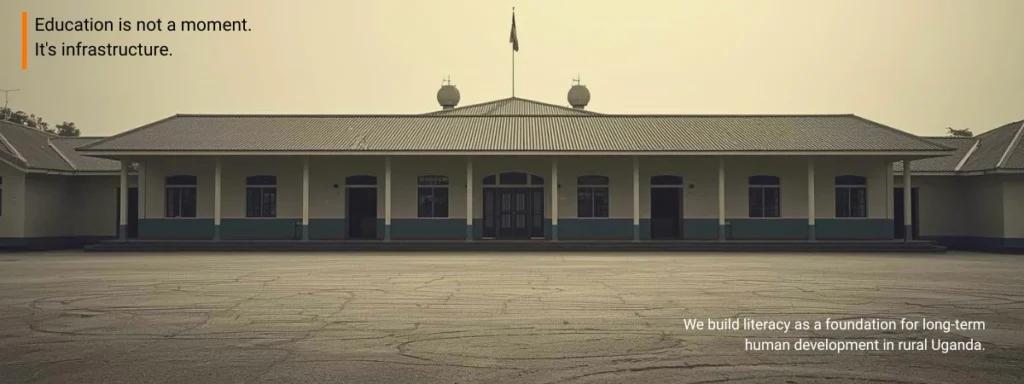
Every child who learns to read in rural Uganda,
every girl who discovers her worth through education,
carries forward a small echo of that belief.
Not as dependency.
But as shared responsibility.
So let me say this plainly, and sincerely:
If these ideals are not protected, refined,
and given room to breathe,
few others will sustain them.
The world needs this kind of courage.
And for that, again,
Asante sana.
3. Your Culture of Lifelong Learning and System Building

You have made learning a lifelong companion
and a way of life.
In your world, curiosity is not confined to childhood;
it is a lifelong companion.
You ask questions without hesitation.
You take classes for pleasure.
You read not only to know,
but to understand.
You seem to believe that almost any kind of learning:
technical, artistic, scientific, personal,
has the power to improve a life.
From libraries that welcome everyone
to podcasts that cross borders freely,
you have made learning part of the public air you breathe.
That is why your societies keep evolving.
You do not stop at knowing,
you keep asking.
And you are right to do so.
Because with every honest question, new doors open:
for medicine,
for technology,
for art,
for justice,
for democracy itself.
There is something quietly remarkable in this:
the way a mechanic, a retiree, and a student
can sit in the same evening class,
not because they must,
but because they can.
Because they want to. It speaks of a society that treats education
not as a privilege,
but as culture, an inseparable part of the environment;
something shared, expected, and alive.
Education is a matter of culture, not privilege.

You have built environments where curiosity is not punished,
but protected.
Where innovation is not an accident,
but the predictable result of people encouraged
to keep asking why.
In doing so, you have shown something subtle but profound:
progress is rarely spontaneous.
What looks like progress is usually the result
of foundations built long before anyone notices them.
Your love of learning has done more than produce institutions.
It has shaped posture.
You have taught that knowledge is not static.
It grows.
It corrects itself.
It learns to listen.
And that willingness to learn, and relearn,
has allowed your societies to hold their ground,
not because you claim to know everything,
but because you never stop seeking.
This is learning as infrastructure.
Not an intervention.
Not a moment.
But a system that carries generations forward.
You Believe in Systems — and in Reform
Alongside this culture of learning,
you hold another conviction just as powerful:
systems matter.
Earlier, we honoured the strength of systems
that create reliability and trust.
Here, something equally important appears:
your belief that systems can be examined,
challenged,
and rebuilt.
You believe in audits.
In feedback loops.
In reform.
You trust that no institution is too sacred to question.
That instinct is rare.
In many places, systems are inherited and feared.
To question them is to offend.
To challenge them is to risk exclusion.
But you ask hard questions.
You publish reports.
You attend town halls and say,
“This isn’t working. Let’s fix it.”
You hold structures accountable
not to perfection,
but to service.
And in doing so, you reveal something essential:
if progress lasts, it was built that way.
Honesty is the beginning of progress
Beneath this posture lies something even more demanding:
honesty.
Not only with others,
but with yourselves. You name what is broken.
You admit what is unjust.
You accept that truth, even when uncomfortable,
is the beginning of change.
What We’ve Learned at Baino Social Impact

At Baino Social Impact, we have learned from this example.
We audit our donor flows.
We question our assumptions.
We invite feedback from communities
who have been spoken over for far too long.
We have learned that, while compassion can respond to suffering,
only structure can prevent it from recurring.
Systems can be respected
without being protected from scrutiny.
Institutions can endure
precisely because they evolve.
Structure and soul can coexist.
Ambition can live beside humility.
Curiosity can change destiny
This second part of ‘Six Things I Admire About the West’ highlights the cultural values of generosity and lifelong learning that are prevalent in the West. These virtues inspire our mission to fight poverty, promote education, and empower rural Uganda.
We believe, as you do,
that every open book,
every lesson,
every conversation under a mango tree
can be a quiet act of liberation.
In rural Uganda, when a child learns to read,
they are not simply gaining a skill.
They are stepping into the same current of curiosity
that has carried your societies forward.
They begin to ask a simple question:
“Why not?”
And that question,
spoken softly in a small classroom,
can become revolutionary.
It can change a family.
It can change a village.
It can change a future.
You have highlighted to me that learning is not merely a ladder out of poverty.
It is light itself.
And once lit,
light does not ask where it came from.
It simply shines.
We hold the same faith.

Every future rests on something built long before it arrives.
And every child who learns to read
is stepping into a world
where curiosity can change destiny.
But learning reaches its fullness
only when it lifts everyone.
And that is where your next behavioural system emerges —
because when learning lifts everyone,
dignity becomes the curriculum.
Conclusion
When generosity is structured, and learning is shared

As I reflect on these two behavioural patterns;
your generosity and your culture of lifelong learning,
I am reminded of something quietly profound:
Every society carries strengths.
Every culture holds gifts.
But not every community chooses to let those gifts travel beyond itself.
You have.
Your generosity reaches across oceans,
toward lives you may never meet.
Your commitment to learning stretches across decades,
across professions,
across generations.
One breathes compassion into systems.
The other builds systems that allow compassion to endure.
Together, they have shaped much of what the world recognises in the West,
and much of what we are learning to build at Baino Social Impact.
Because these are not merely cultural habits.
They are long-term human investments.
They ripple outward in ways none of us can fully trace.
Every book placed in a child’s hands,
every classroom stabilised,
every future gently widened in rural Uganda
carries a quiet echo of your example:
Give beyond yourself.
Learn without end.
Build structures that can hold dignity.
So my gratitude is not fleeting.
It is deliberate.
Your influence reaches further than you may ever see.
It meets children who will never know your names.
It meets families far from your borders.
It meets us here,
shaping how we design, refine, and sustain hope.
This is where Part Two rests.
Not as a conclusion,
but as a foundation laid.
Looking Ahead To Where Dignity and Discipline Enter the Design

What follows next moves even closer to the moral architecture beneath your progress.
In Part Three, we turn toward two virtues that carry particular weight;
not because they are loud,
but because they are structural.
4. Your Respect for Human Dignity and Equal Worth
A principle so simple it is often underestimated,
yet powerful enough to reshape institutions,
especially in societies where worth is still rationed by tribe, gender, or class.
5. Discipline: The Quiet Power Behind Your Progress
The discipline that does not announce itself,
yet builds systems,
sustains institutions,
and turns intention into continuity.
If generosity reveals the heart,
and lifelong learning shapes the mind,
then dignity and discipline reveal something deeper still:
the conditions that allow societies to hold together under pressure.
Part Three does not introduce new admiration.
It examines what keeps that admiration standing.
And why we still have much to learn from it.