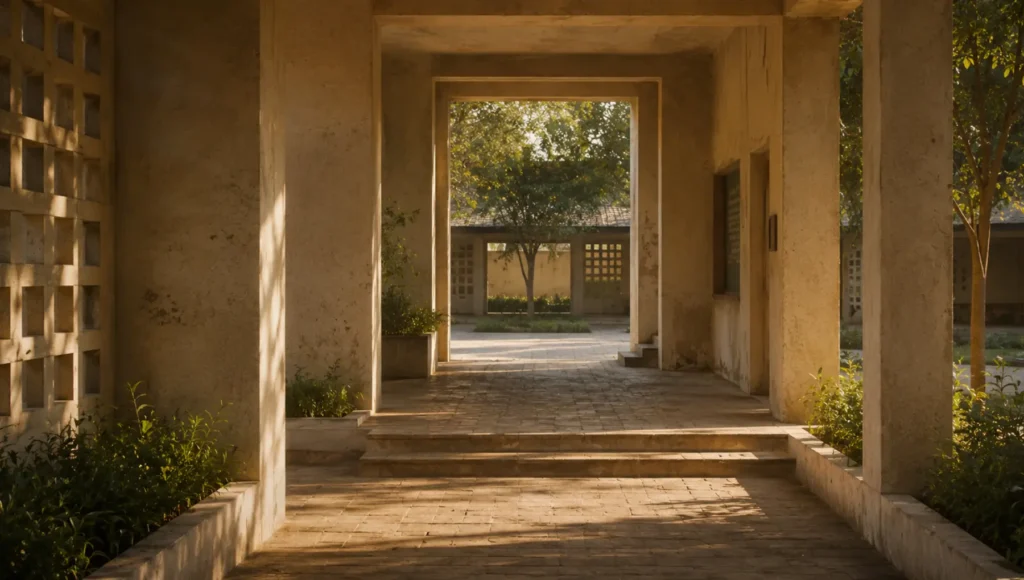
The conditions that make learning possible before instruction begins
*This article is part of a series on how learning begins, develops, and continues within physical communities.
Progress does not arrive.
It is built.
And what allows it to be built is not momentum or intention, but condition.
Progress is often spoken of as though it arrives on its own.
As though, given enough time, people and communities will naturally move forward.
As though opportunity, once introduced, will quietly take root and grow.
But what allows progress to be built is not momentum, nor urgency, nor even good intention.
It is condition.
At Baino Social Impact, we begin here.
We understand community care not as an act of response,
but as part of the structure that makes human development possible.
Not as something added after the fact,
but as something that quietly shapes whether growth can begin at all.
Because learning does not begin with instruction.
It begins with stability.
The ground on which learning stands
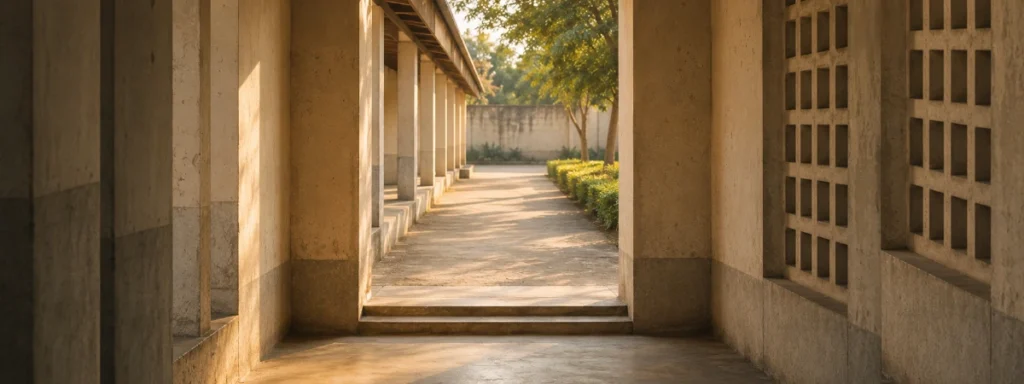
A child can sit in a classroom and still remain far from learning.
Not because ability is absent.
Not because potential is missing.
But because the environment surrounding that child does not yet hold steady enough for learning to take root.
Attention requires calm.
Curiosity requires safety.
Discipline requires continuity.
Hope requires some form of predictability.
Without these, learning becomes fragile.
It appears, then disappears.
It struggles to deepen.
It struggles to stay.
This is why, in our work, we do not separate education from environment.
Literacy is not only a skill to be transferred.
It is something that grows within a setting.
A setting shaped by relationships, routines, expectations,
and the quiet signals that tell a child:
whether effort is worthwhile,
whether tomorrow can build on today,
and whether their future deserves preparation.
Where those signals are unstable, learning struggles to mature.
Community care as structure
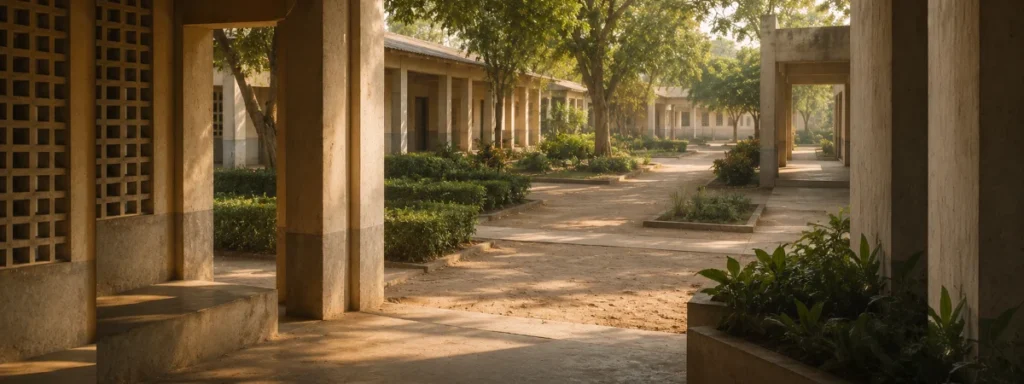
When we speak of community care,
we are speaking about the work of shaping that setting.
Not as an abstract idea,
but as a lived environment.
An environment where children can return to something steady.
Where households are not constantly pulled apart by instability.
Where guidance is present.
Where dignity is protected.
Where daily life carries enough order for growth to continue.
This kind of care is not defined by intensity.
It is defined by consistency.
It does not rely on moments.
It relies on patterns.
It is expressed in the reliability of presence.
In the predictability of support.
In the quiet reinforcement of values that make learning sustainable over time.
In this sense, community care is not separate from education.
It is part of the architecture that allows education to hold.
Stability as a condition of freedom
There is a tendency to think of stability as something passive.
Something that simply exists when problems are absent.
We see it differently.
Stability is an active condition.
It allows the mind to move beyond reaction.
It allows attention to extend beyond survival.
It allows effort to accumulate.
Without it, even strong interventions struggle to last.
With it, even modest opportunities begin to compound.
This is where literacy becomes more than instruction.
Literacy, in its fullest sense,
is the expansion of a person’s ability to think, to interpret, to participate,
and to act with awareness in the world around them.
But that expansion depends on continuity.
It depends on whether a person can return, again and again,
to the work of learning without being pulled away by instability.
It depends on whether the environment around them supports repetition, reflection, and growth.
This is why we say that literacy is environment.
Not because books are absent,
but because the conditions that allow engagement with them are not yet secure.
The scale of the environment
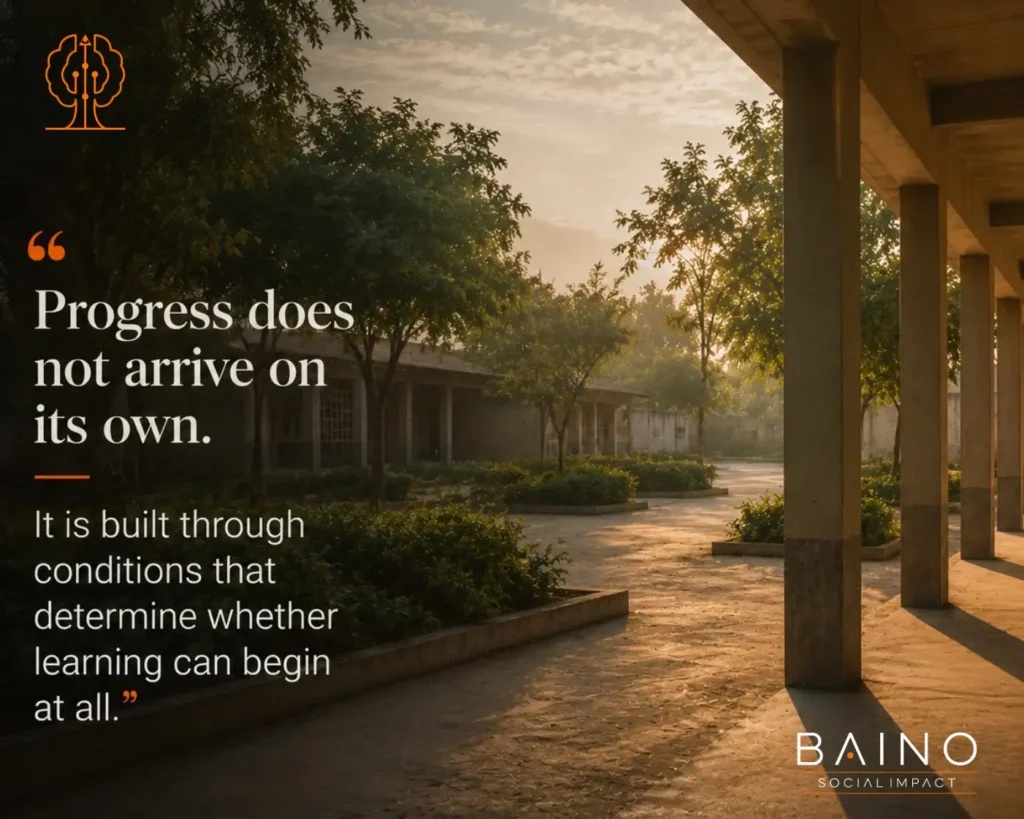
A learning environment is often imagined as a place.
A classroom.
A school.
A building.
But in reality, it is larger.
It includes the home where language is shaped.
The community where behaviour is observed and absorbed.
The emotional climate in which effort is either strengthened or weakened.
The social rhythms that signal what matters and what does not.
This wider environment is always teaching.
It teaches through repetition.
Through example.
Through expectation.
And over time, it forms the boundaries within which learning either expands or contracts.
To care for a community, then, is to take responsibility for this wider field of influence.
Not to control it,
but to strengthen its capacity to support growth.
What we are building
At Baino Social Impact, our work is grounded in a simple conviction.
Progress is engineered.
Dignity is structural.
And literacy is not separate from the conditions of everyday life.
This means we are not only concerned with access to education.
We are concerned with the environments that surround it.
We ask:
Whether learning can begin earlier.
Whether it can continue more steadily.
Whether it can rest on conditions strong enough to sustain it.
Whether communities can become places where education is not an interruption,
but a rhythm.
Where growth is not accidental,
but supported.
Where children are not left to navigate instability alone,
but are held within systems that give their effort a fair chance to mature.
This work is quiet.
It does not always announce itself.
But over time, it shapes what becomes possible.
Conclusion
Before progress becomes visible, it must first be made possible.
And what makes it possible are conditions that can hold.
Stability is one of those conditions.
Not as an ideal,
but as a foundation.
Not as a luxury,
but as part of the ground on which learning stands.
This is why we understand community care as foundational work.
It is the work of strengthening the environments in which human growth can take root.
The work of ensuring that learning is not repeatedly interrupted before it has the chance to deepen.
The work of giving effort somewhere to land and remain.
Because where stability holds, learning begins.
And where learning begins, progress can be built.
But what does this stability actually do within the learner?
Every article is one part of a larger system.
Follow the connections between principles, practice, observation, and community life to explore how lasting progress is built.
The Space Between Worlds
Explore the deeper reasoning behind Baino’s belief that progress depends on conditions, structure, and continuity before visible change can occur.
How Stability Shapes Attention, Trust, and Learning
A closer look at how stable conditions influence attention, confidence, trust, and the ability to engage with learning over time.
The Pathways That Carry Learning Into Participation
Explore the structures, transitions, and pathways that carry learning beyond preparation and into meaningful participation.
The Long Walk to School Begins Before Learning Does
An observation of how conditions surrounding a child’s journey to school begin shaping learning long before instruction starts.
Read Field Note →It is designed. This system helps us build it with intention, clarity, and continuity.
Four Directions.
One Purpose.
These four directions help you explore the framework from every angle: returning to the foundation, connecting related ideas, continuing forward, and seeing how it all comes to life in the real world.