Why We Begin With Questions
Over the past few days, we’ve been sharing a series of five short posts exploring how Baino builds lasting educational change.
If you’ve been following them from the beginning, you may have noticed something unusual.
We never began by describing what we do.
We didn’t start by introducing the five guiding pillars that shape our work. We didn’t begin by outlining our approach or explaining how Baino builds change.
Instead, we began somewhere quieter.
With questions.
That wasn’t accidental.
It reflected something we’ve gradually learned through years of studying education, community development, and the conditions that allow progress to endure across generations.
Again and again, we’ve seen worthwhile projects improve lives.
We’ve also seen how easily that progress becomes difficult to sustain when the foundations beneath it remain unchanged.
That observation quietly transformed how we think about lasting change.
Before we can appreciate what builds lasting progress, we first need to recognise what quietly causes it to break.
Only then does the way Baino builds change become meaningful.
That is why this series began with questions instead of finished answers.
Why Questions Matter
Finished answers are easy to admire.
They are much harder to understand.
Questions slow us down.
They invite us to notice what usually remains hidden.
They redirect our attention from visible outcomes to the conditions that quietly produce them.
Instead of asking us to accept a conclusion, they invite us to discover why that conclusion becomes necessary.
That difference matters.
When we discover something for ourselves, it becomes part of how we see the world rather than simply another idea we’ve been told to remember.
That is why questions have become an important part of how Baino teaches and shares information.
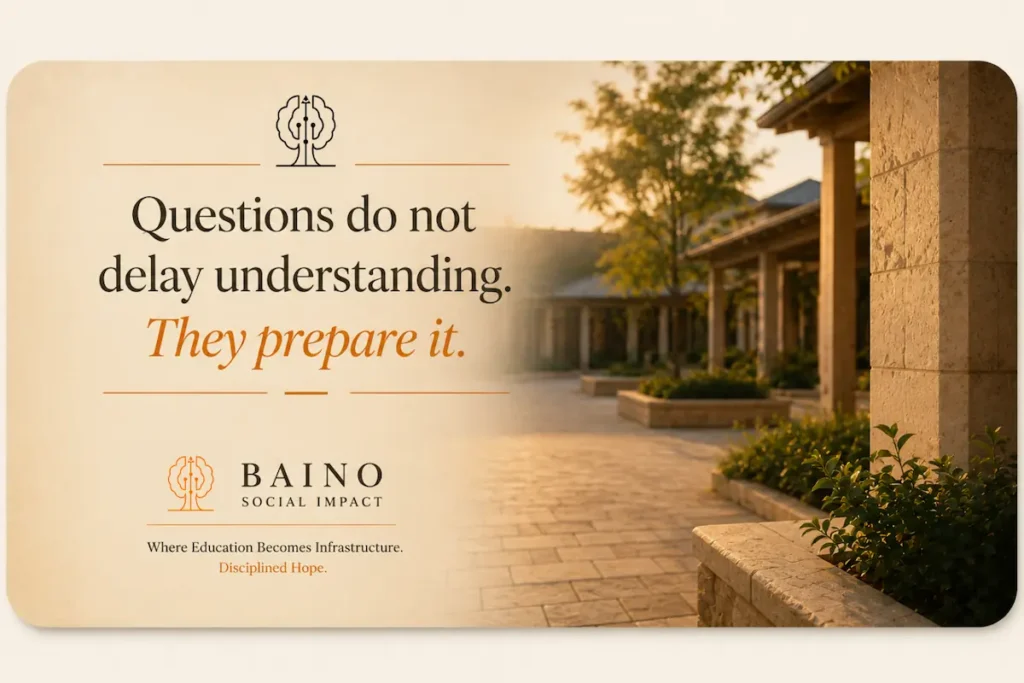
Questions do not delay understanding.
They prepare it.
And so, over time, as we’ve continued learning, we have become convinced that this approach benefits not only our own work but also the communities we serve, the partners who work alongside us, and everyone seeking to understand how lasting educational progress is built.
A Journey Through Five Questions
Every post in this series prepared the next.
Each one quietly introduced another way of seeing.
Rather than presenting the whole picture immediately, the series gradually built a way of understanding that eventually made the complete picture feel both natural and necessary.
That journey mattered just as much as the destination.
Looking Beneath Visible Outcomes
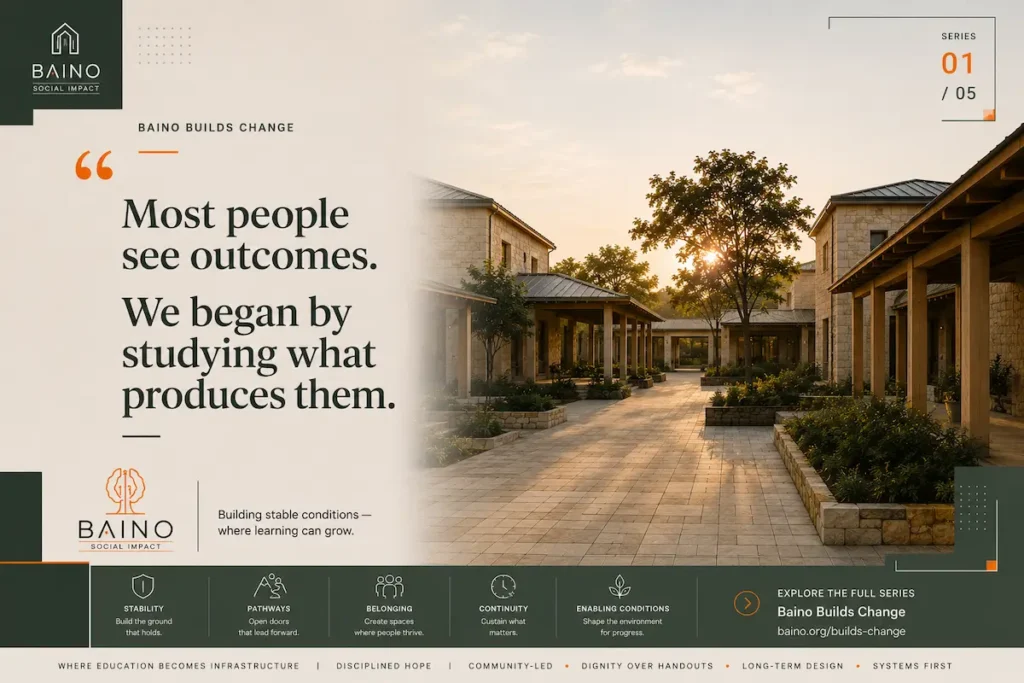
The first post invited us to look beneath visible results.
Most conversations about change begin by celebrating success.
We deliberately began somewhere different.
What produces those outcomes in the first place?
It is an easy question to overlook.
Yet it quietly changes everything.
Once we begin looking beneath visible achievements, we start recognising the foundations that make those achievements possible. Progress stops looking accidental. It begins to reveal the conditions that patiently carried it there.
In many ways, this first question established one of Baino’s enduring convictions:
lasting progress is designed beneath the surface long before it becomes visible above it.
Looking Beyond Individual Projects
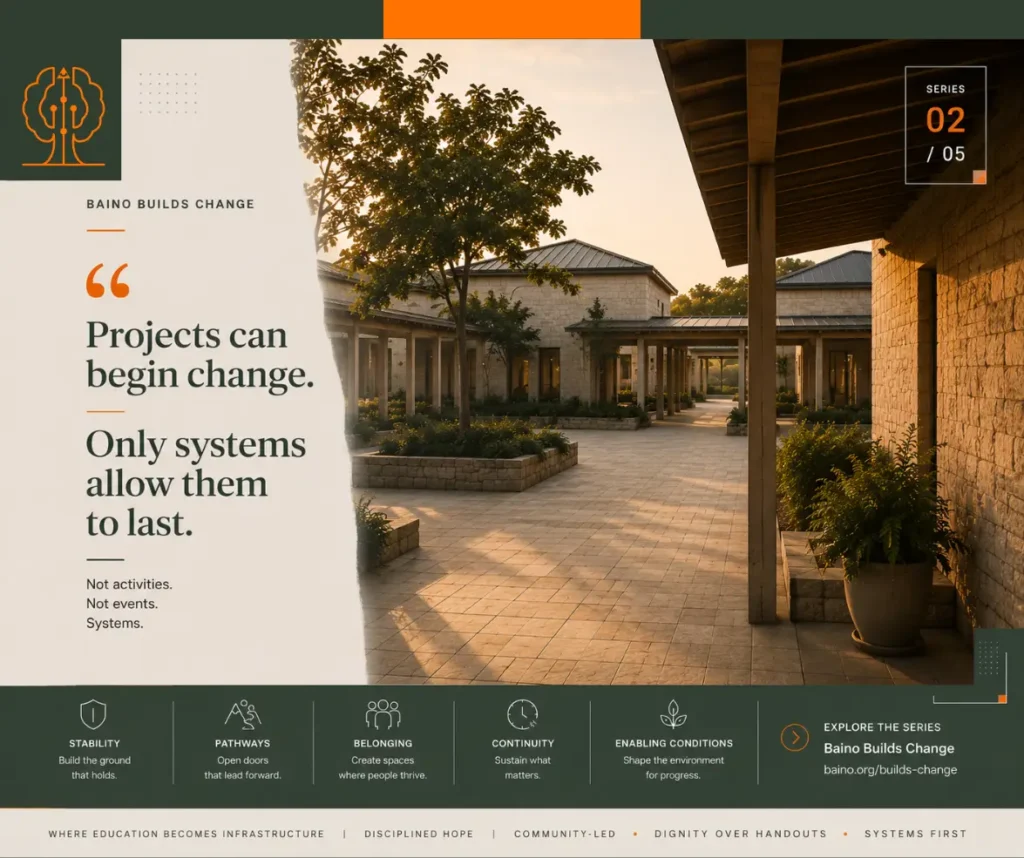
The second post asked another question.
If projects improve lives, why do so many improvements fade over time?
This was never a criticism of projects.
Projects matter.
Many of them begin important change.
But lasting educational progress depends on something larger than any individual activity.
It depends on whether those activities strengthen the wider system that allows learning, participation, and opportunity to continue long after the project itself has ended.
That shift changes how success is measured.
Instead of asking only what today’s project achieved, we also begin asking what tomorrow’s community will inherit because of it.
Education becomes more than a collection of programmes.
It becomes living infrastructure that carries progress forward.
Education is an environment.
Protecting Every Stage
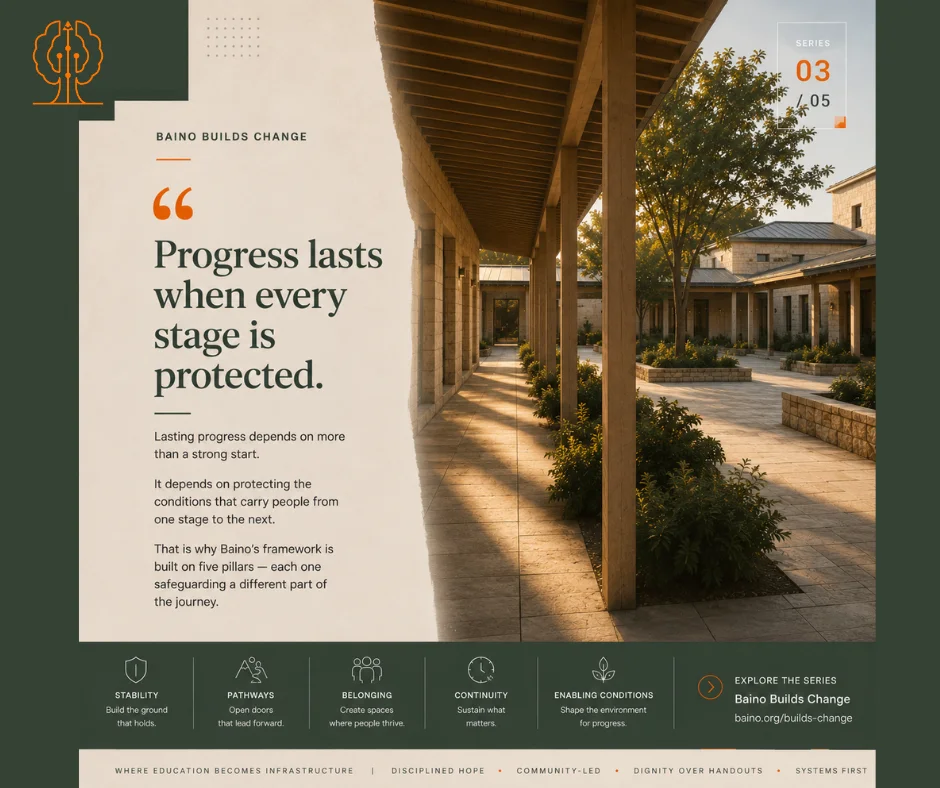
The third post gently shifted our attention again.
Strong beginnings matter.
But lasting progress is rarely determined by beginnings alone.
It depends upon protecting every stage that follows.
A pathway that never forms.
A sense of belonging that never develops.
A period of instability that quietly interrupts what had begun so well.
Each one weakens the whole journey.
This reminds us that progress is rarely sustained by momentum alone.
It is sustained by continuity.
Every stage prepares the next.
Every stage quietly carries the possibility of what follows.
When we protect those stages, we protect far more than individual moments.
We protect the journey itself.
Strengthening Every Connection
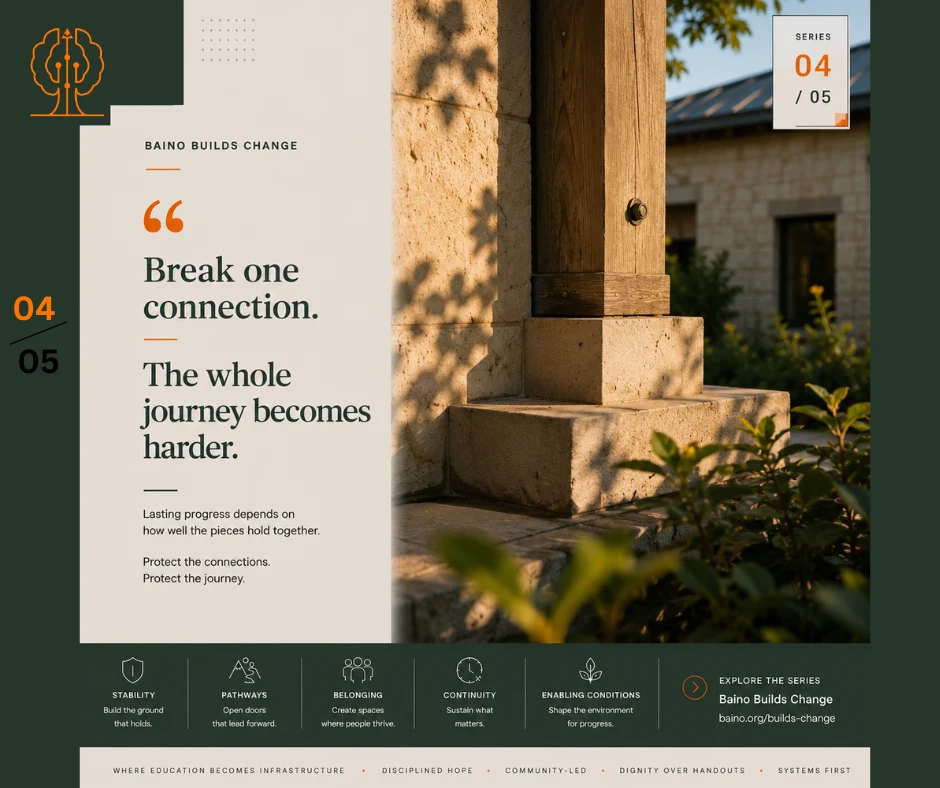
The fourth post invited us to look even deeper.
Stages alone are not enough.
They must remain connected.
A strong beginning cannot compensate for a broken pathway.
A healthy learning environment cannot fully overcome interrupted participation.
A well-designed opportunity cannot fulfil its purpose if the next stage has quietly disappeared.
Break one connection.
The whole journey becomes harder.
That insight reminds us that lasting progress grows through coherence.
The conditions supporting educational change do not compete with one another.
They strengthen one another.
Continuity is not created by isolated success.
It is carried by relationships that remain strong over time.
Bringing the Journey Together
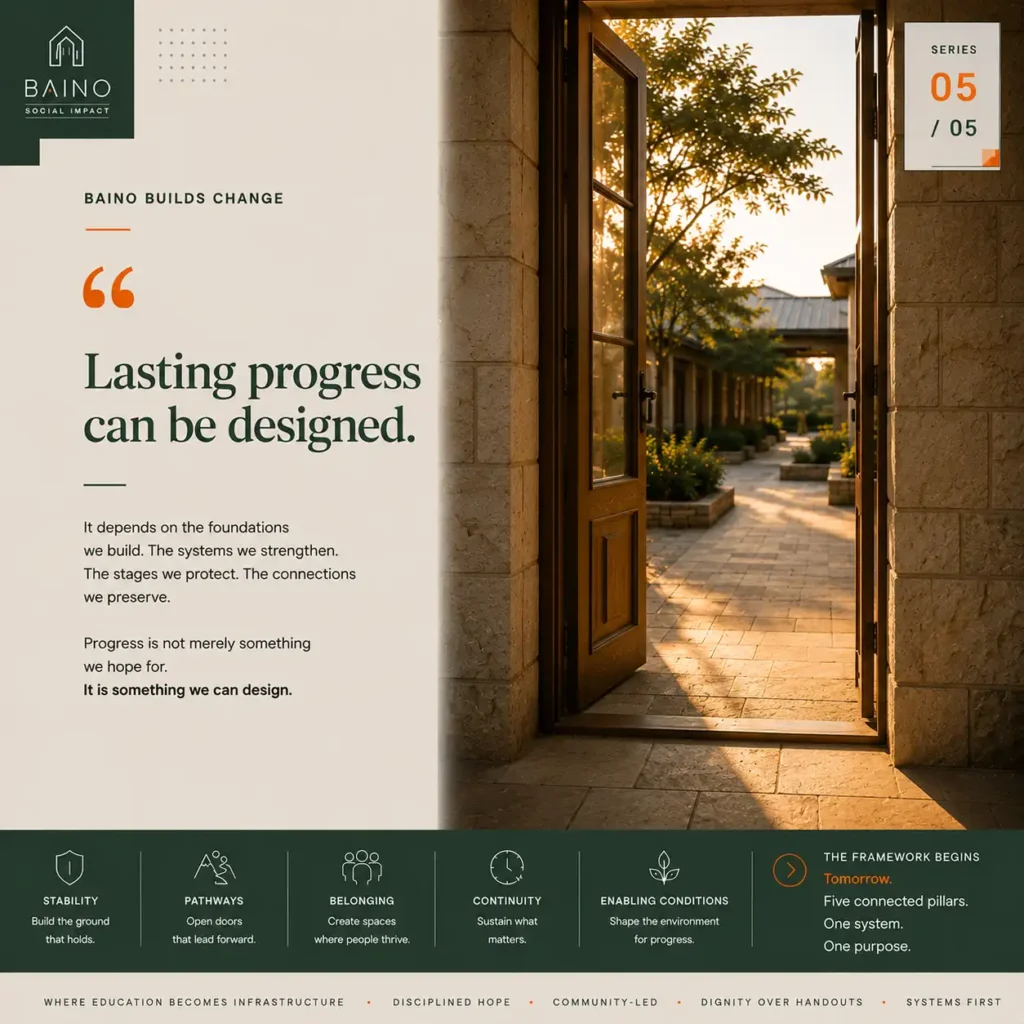
Only after travelling through these questions did we arrive at the final post.
By then, introducing How Baino Builds Change no longer felt like presenting a new idea.
It felt like giving shape to something we had already begun discovering together.
The five pillars did not appear as separate concepts waiting to be accepted.
They emerged as the natural response to the questions we had already explored.
The journey had quietly prepared us to understand them.
What first appeared to be a series of individual posts revealed itself as one connected conversation.
Foundations.
Systems.
Continuity.
Connections.
Together, they showed that lasting educational progress is not merely something we hope for.
It is something that can be intentionally built.
Why We Chose This Journey
Looking back, these five posts were never simply introducing a page.
They were preparing a way of seeing.
The questions mattered just as much as the answers.
Without them, the five pillars could easily have appeared as another organisational model.
Instead, they became the natural response to questions we had already explored together.
People understand complex ideas more deeply when they first understand the questions that made those ideas necessary.
That is why we chose to begin with curiosity rather than conclusions.
Not because questions are more important than answers.
But because good questions prepare people to recognise the value of good answers.
This Is How Baino Invites People Into Its Work

As this series came together, something became clearer to us.
This is not simply how we introduced one page.
This is how we want to continue introducing our work.
Whether we’re sharing research, launching a new initiative, publishing an essay, introducing another educational framework, or exploring a different challenge, we’ll continue beginning where understanding naturally begins.
Not with finished answers.
With the questions that make those answers meaningful.
We hope that as you continue following Baino’s work, you’ll begin noticing this rhythm.
Sometimes we’ll begin beneath visible outcomes.
Sometimes we’ll begin with systems.
Sometimes with continuity.
Sometimes with the quiet connections that carry progress from one generation to the next.
But wherever the journey begins, it will always be leading toward the same conviction.
That lasting educational progress is not built by chance.
It grows from strong foundations.
It is carried by connected systems.
It is protected through continuity.
And it is strengthened by communities that patiently build the conditions under which learning, dignity, and opportunity can endure.
These five questions have done what they were meant to do if they helped you see lasting educational progress a little differently.
If you’re ready to take the next step, we invite you to see how those same questions come together in a connected understanding of how Baino builds lasting educational change. It is a system of foundations, pathways, continuity, and shared responsibility that strengthens communities over time.
That journey continues in How Baino Builds Change.
Understanding grows by following the connections.
Continue through Baino’s essays, field observations, frameworks, and publications to see how lasting educational progress is understood, built, and sustained.
The Space Between Worlds
Discover the foundational essay that first shaped Baino’s understanding of lasting educational progress.
How Baino Builds Change
Explore the five interconnected pillars that explain how lasting educational progress is intentionally strengthened over time.
Orientation Series
Return to the five-part series that gradually introduced the questions behind Baino’s approach.
Learning in Practice
See how these ideas appear in everyday community life through Baino’s observations from the field.
It is designed. Every idea, connection, and action contributes to one intentional understanding of lasting change.
Continue Exploring
Essays, reflections, frameworks, and field observations all contribute to one connected understanding of lasting change.