How interruption gradually weakens continuity over time
Part of a series on how learning begins, develops, and continues within real communities.
Progress does not always break at the beginning.
In many cases, movement begins clearly.
A learner engages.
A pathway becomes visible.
Effort accumulates.
Participation starts to feel possible.
And for a time, continuity holds.
But then, pressure begins to build.
The rhythm weakens.
Return becomes less consistent.
Continuation becomes harder to sustain.
And this is where many journeys quietly begin to fragment.
Progress is most vulnerable during continuation
There is a common assumption that the hardest part is starting.
But in many contexts, the more fragile stage is continuation.
Because once progress begins, it depends on something more demanding than initial movement.
Consistency.
Return.
The ability to remain connected to the path over time.
And this is where instability begins to accumulate pressure against continuity.
Pressure rarely arrives all at once
The forces that interrupt progress are rarely dramatic.
They accumulate gradually.
An unexpected expense.
A shift in household priorities.
Reduced income.
Increased responsibilities.
Disrupted routines.
Each pressure on its own may appear manageable.
But together, they begin competing with continuation.
And over time, the balance shifts.
The path begins competing with immediate reality
When pressure intensifies, people adjust.
Not because learning has lost value.
But because immediate demands begin overriding long-term continuation.
Time is redirected.
Energy becomes divided.
Attention is pulled elsewhere.
And slowly, remaining connected to the path becomes more difficult to sustain.
Not impossible.
But increasingly fragile.
Interruption often appears temporary
When continuity weakens, it rarely appears final at first.
It looks like a pause.
A temporary step away.
A delayed return.
A disruption that feels manageable in the moment.
But without stability, interruption accumulates.
And what once felt temporary slowly becomes distance.
Restarting requires more than continuing
Once continuity breaks, returning is rarely simple.
Momentum weakens.
Routine disappears.
Connection to the path fades.
What once felt familiar begins to feel distant again.
And the effort required for re-entry becomes heavier than continuation would have been.
This is why many journeys do not fully resume.
Not because movement was impossible.
But because interruption repeatedly increased the cost of return.
Progress breaks where continuity is exposed
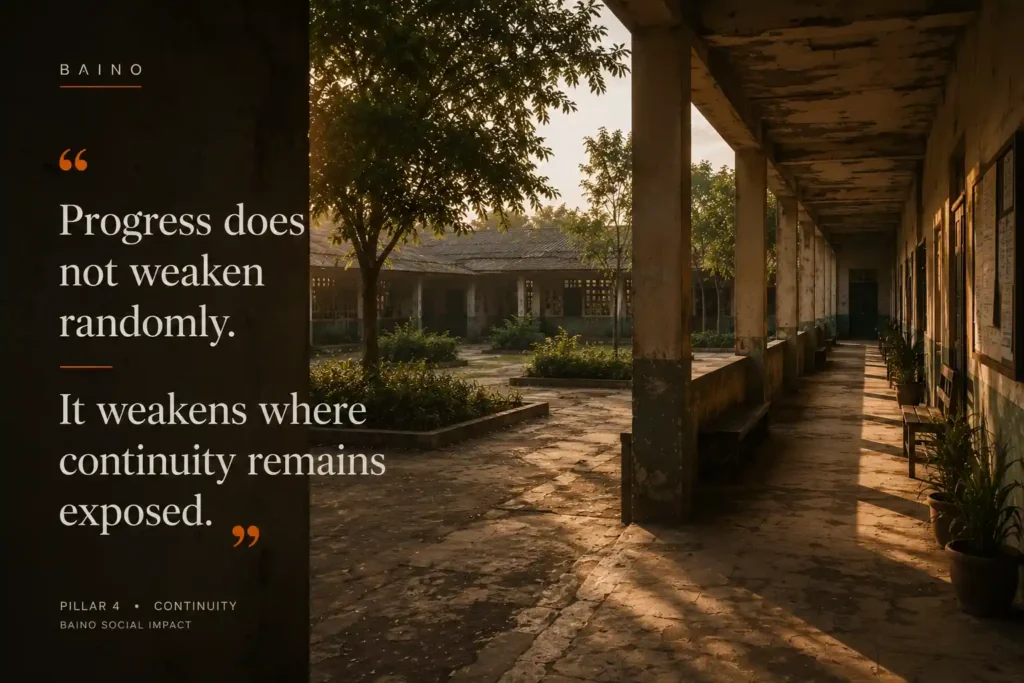
At its core, this pattern reveals something important.
Progress does not weaken randomly.
It weakens where continuity remains structurally exposed.
Where continuation depends on conditions that are still unstable.
Where effort remains vulnerable to repeated disruption.
Where participation cannot yet withstand pressure over time.
What this reveals
The challenge is not always beginning.
And it is not always intention.
It is the fragile space between starting and sustaining.
Where progress depends on continuity, but continuity is still under pressure from instability, interruption, and competing realities.
This is where many journeys quietly lose momentum before participation can fully take hold.
Conclusion
Progress often weakens midway.
Not because the direction was wrong.
But because continuity was not yet strong enough to withstand repeated pressure.
This is why it matters to understand how interruption gradually weakens continuity over time.
Not only because it slows movement, but because instability accumulates over time.
Return becomes harder.
Participation becomes fragile.
And what once felt possible begins to drift further away.
But continuity does not weaken on its own.
It weakens where surrounding structures are unable to absorb pressure strongly enough to protect continuation over time.
And this raises another question:
What allows some environments to sustain continuity more successfully than others?
Every article is one part of a larger system.
Follow the connections between principles, practice, observation, and community life to explore how lasting progress is built.
The Space Between Worlds
Explore the deeper reasoning behind Baino’s belief that progress depends on conditions, continuity, and structures that can withstand pressure over time.
When Progress Is Interrupted
Explore why continuity determines whether learning can continue into participation over time.
What Protects Progress from Breaking
Explore why continuity survives more effectively in some environments and what helps progress remain connected through disruption.
School Does Not Always Set the Schedule
An observation of how competing demands, household realities, and shifting priorities influence continuity over time.
Read Field Note →It is designed. This system helps us build it with intention, clarity, and continuity.
Four Directions.
One Purpose.
These four directions help you explore the framework from every angle: returning to the foundation, connecting related ideas, continuing forward, and seeing how it all comes to life in the real world.