How environment shapes focus, consistency, and the ability to keep learning over time
This article is part of a series on how learning begins, develops, and continues within communities.
Learning is often judged by what can be seen.
Participation.
Performance.
Results.
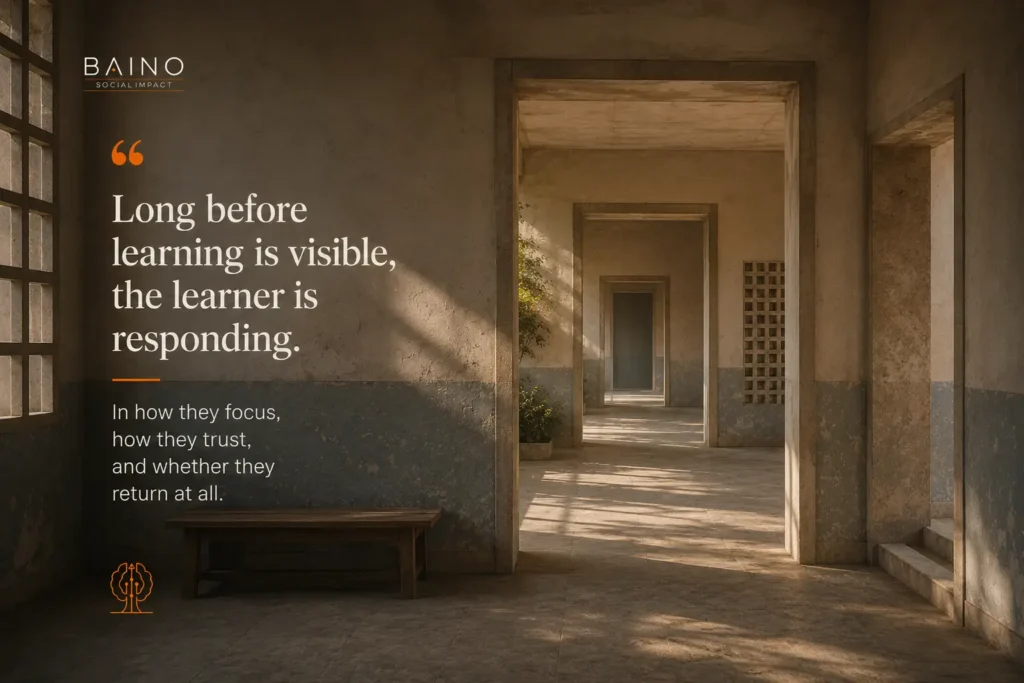
But long before learning becomes visible,
it is shaped by the conditions surrounding the learner.
The learner is responding to their environment.
Not consciously, and not all at once, but steadily.
In how they focus.
In how they trust.
In whether they return.
These responses shape the depth of learning more than instruction alone.
Attention is shaped before it is directed
We often speak of attention as something a person chooses to give.
But attention is also something the environment allows.
Where life is crowded with disruption, attention fragments.
Where unpredictability is constant, the mind learns to scan rather than settle.
In such conditions, asking for focus is not enough.
Because attention has already been shaped elsewhere.
But where the environment holds more steadily, something shifts.
Attention begins to rest.
Not perfectly, but long enough to engage.
Long enough to return.
And where attention can return, learning begins to deepen.
Trust determines how far a learner will go
Learning requires more than presence.
It requires a willingness to invest effort over time.
That willingness is shaped by trust.
Trust that guidance will remain.
Trust that effort will not be wasted.
Trust that the process is worth continuing.
Where this trust is weak, learning becomes cautious.
People participate, but they hold back.
They try, but they do not fully commit.
But where trust is built through consistency, engagement changes.
The learner begins to extend themselves.
To take risks.
To stay longer than they otherwise would.
And that is where growth begins to compound.
Rhythm turns effort into progress

Effort alone does not create learning.
Effort that returns does.
This is the role of rhythm.
The ability to come back to the same task.
To repeat.
To build gradually.
But rhythm is not created by motivation alone.
It depends on whether life allows for return.
Where interruptions are frequent, effort resets.
Where continuity is weak, progress remains shallow.
But where some form of rhythm is possible, even imperfectly, learning begins to accumulate.
Not dramatically, but steadily.
And over time, that steadiness becomes strength.
The learner is not passive
At this point, it is easy to assume that learning is simply the result of environment.
It is not.
Two people can share the same environment and respond differently.
One may engage.
Another may withdraw.
One may persist.
Another may stop.
The environment shapes what is possible.
But the learner still chooses what to do within it.
This is where agency remains.
And it is why environment alone is not enough.
But it is also why environment matters so much.
Because it determines how difficult that choice becomes.
Whether engagement feels reachable or distant.
Whether effort feels supported or strained.
What this reveals

Attention, trust, and rhythm are not separate ideas.
They are responses.
They reflect how a person is experiencing the world around them.
And over time, they shape whether learning remains surface-level or becomes something deeper.
This is why learning cannot be understood only through teaching.
It must also be understood through the conditions that shape these responses.
Conclusion
Learning does not begin with performance.
It begins with the quiet formation of attention, trust, and rhythm.
These are not taught directly.
They are shaped through experience.
Through the environments people move within.
Through the consistency they encounter.
Through the signals they receive about whether effort is worth giving.
And within those conditions, the learner still chooses.
To engage.
To return.
To continue.
Where those conditions hold, that choice becomes easier to sustain.
And where it is sustained, learning begins to take shape.
But these patterns do not remain within individuals alone. Over time, they begin to appear across many lives at once.
Every article is one part of a larger system.
Follow the connections between principles, practice, observation, and community life to explore how lasting progress is built.
The Space Between Worlds
Explore the deeper reasoning behind Baino’s belief that lasting progress depends on conditions, structure, and continuity before visible outcomes appear.
Why Learning Begins with Stability
Explore the conditions that make learning possible before instruction begins.
How Communities Shape the Course of Learning
Explore how repeated patterns within communities influence learning across many lives over time.
An Iron-Sheet Roof in the Afternoon Heat
An observation of how physical conditions quietly influence concentration, participation, and learning throughout the school day.
Read Field Note →It is designed. This system helps us build it with intention, clarity, and continuity.
Four Directions.
One Purpose.
These four directions help you explore the framework from every angle: returning to the foundation, connecting related ideas, continuing forward, and seeing how it all comes to life in the real world.