
How Expectations Shape Outcomes
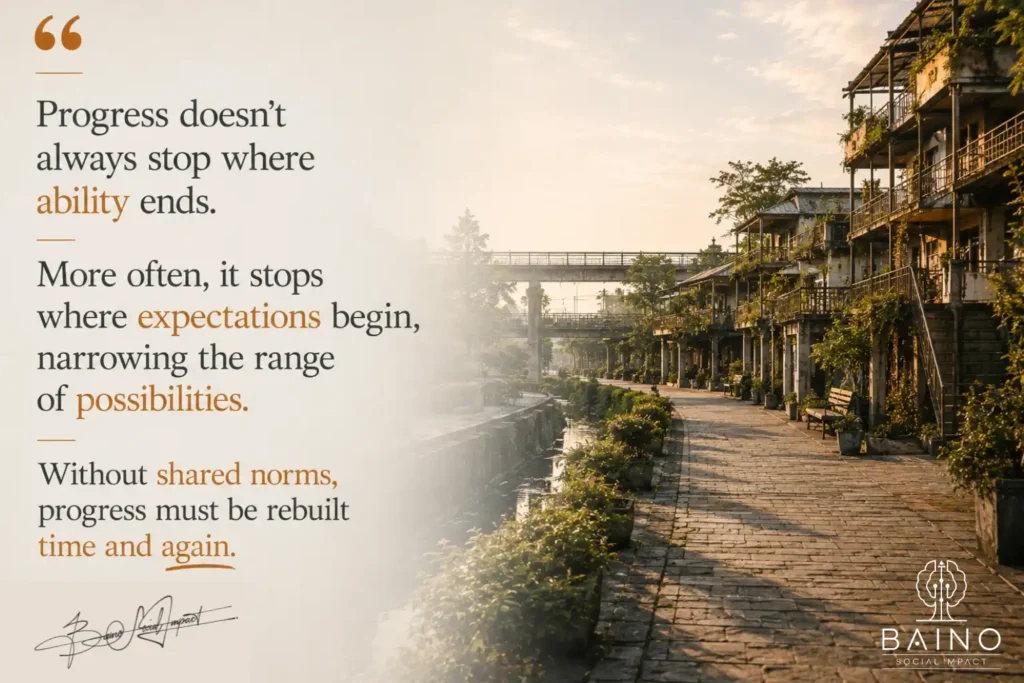
Progress does not always stop where ability ends.
More often, it settles where expectation begins narrowing the range of continuation.
Part of a series on how learning begins, develops, and continues within real communities.
The limits that are never stated

In every community, there are boundaries.
Not formally announced.
Not openly agreed upon.
But gradually absorbed through the environment itself.
They appear in what people pursue.
In how far movement usually extends.
In where progress tends to slow, settle, or quietly stop repeating itself.
These limits are rarely introduced directly.
They are learned through exposure.
Through what is visible.
Through what continues.
Through what people repeatedly see sustained around them over time.
And gradually, these patterns begin feeling less like limitations and more like ordinary reality.
People rarely move beyond what they can see sustained
Individuals may begin with ambition.
They may attempt movement beyond what is common.
They may move toward outcomes that appear unfamiliar within their environment.
But over time, a quieter force begins shaping how far that movement continues.
People look around and observe what tends to hold.
How far others usually go and achieve what they achieve.
What forms of progress appear stable enough to continue across time.
What outcomes seem repeatedly reinforced by the surrounding environment.
And gradually, movement adjusts itself around those patterns.
Not always consciously.
Not as a deliberate surrender.
But as a response to what the environment repeatedly presents as sustainable.
Because people do not only ask:
“What is possible?”
They also ask, often without words:
“What usually continues here?”
Expectations do not prevent beginnings; they shape continuation
In many environments, people are allowed to begin.
Learning starts.
Effort appears.
Progress becomes visible for a time.
But expectations often shape something deeper than beginnings.
They shape how far movement continues before it begins narrowing back toward what the environment already recognises.
Where expectations remain limited, continuation weakens as progress approaches those invisible boundaries.
Where expectations extend further, movement continues with less resistance.
Not because individuals themselves are fundamentally different,
but because the socially visible range of continuation has changed.
What becomes visible begins shaping what feels attainable
Communities establish expectations partly through visibility.
What people repeatedly see sustained over time gradually begins shaping what feels realistic to pursue.
If certain outcomes rarely appear, they begin feeling distant from ordinary life.
If they remain consistently visible, they begin feeling socially reachable.
This process rarely appears as instruction.
It happens through exposure.
Through repetition.
Through environments that quietly communicate what forms of continuation appear capable of holding over time.
And gradually, visibility settles into expectation.
The quiet settling of progress

Most ceilings do not feel like barriers.
They feel like a natural point of arrival.
A place where continuation becomes less visible.
Where movement beyond a certain range begins feeling increasingly unfamiliar.
Where further progress no longer appears socially reinforced in ordinary life.
This is why ceilings are rarely resisted directly.
Because they are not usually experienced as restrictions.
They are experienced as the edge of what the environment repeatedly treats as realistic.
And so movement gradually settles there.
Not suddenly.
Not through force.
But through repeated environmental narrowing across time.
When expectations expand
When expectations begin shifting, movement changes with them.
Not immediately.
Not dramatically.
But gradually and repeatedly across time.
People begin seeing further forms of continuation.
Longer trajectories.
Outcomes that previously appeared unusual becoming more socially visible and reinforced.
And slowly, movement adjusts itself around these wider patterns.
Because what once felt distant begins entering the range of what the environment now treats as sustainable.
Not only in theory,
but through repeated visible continuation.
What this means

If progress is shaped in this way, then outcomes cannot be understood only through individual effort.
They must also be understood through expectation.
Through what environments repeatedly make visible.
Through what forms of movement remain socially reinforced across time.
Through how far continuation is repeatedly seen to extend before narrowing.
Because where expectations settle, movement often settles with them.
Conclusion
Progress does not always stop where ability disappears.
Often, it settles where continuation no longer appears socially reinforced.
Through what is visible.
Through what is repeated.
Through what communities gradually come to recognise as the ordinary range of movement.
When that range narrows, progress narrows with it.
When it expands, movement extends further across time.
And because of this, expectations do more than shape what people hope for.
Over time, they begin shaping what entire communities come to experience as realistic to continue.
But expectations do not emerge on their own.
They are shaped by what people repeatedly see sustained around them.
By what forms of movement remain visible long enough to feel stable.
By whether progress appears capable of continuing beyond isolated individuals and temporary moments.
And over time, the environments that continue producing visible direction are often the ones that quietly reshape what communities believe people can become.
Every article is one part of a larger system.
Follow the connections between principles, practice, observation, and community life to explore how lasting progress is built.
6 Things I Admire About People in the West
Explore observations about the habits, expectations, and social patterns that help expand what communities perceive as possible.
When Progress Becomes Normal
Explore how communities turn isolated effort into lasting continuity through repetition, reinforcement, and shared expectations.
The Direction People Follow
Explore how visible patterns of continuation shape the directions people perceive as worth pursuing.
Three Textbooks Across a Classroom
An observation of how visible conditions shape expectations, participation, and the range of outcomes that appear realistic.
Read Field Note →It is designed. This system helps us build it with intention, clarity, and continuity.
Four Directions.
One Purpose.
These four directions help you explore the framework from every angle: returning to the foundation, connecting related ideas, continuing forward, and seeing how it all comes to life in the real world.